
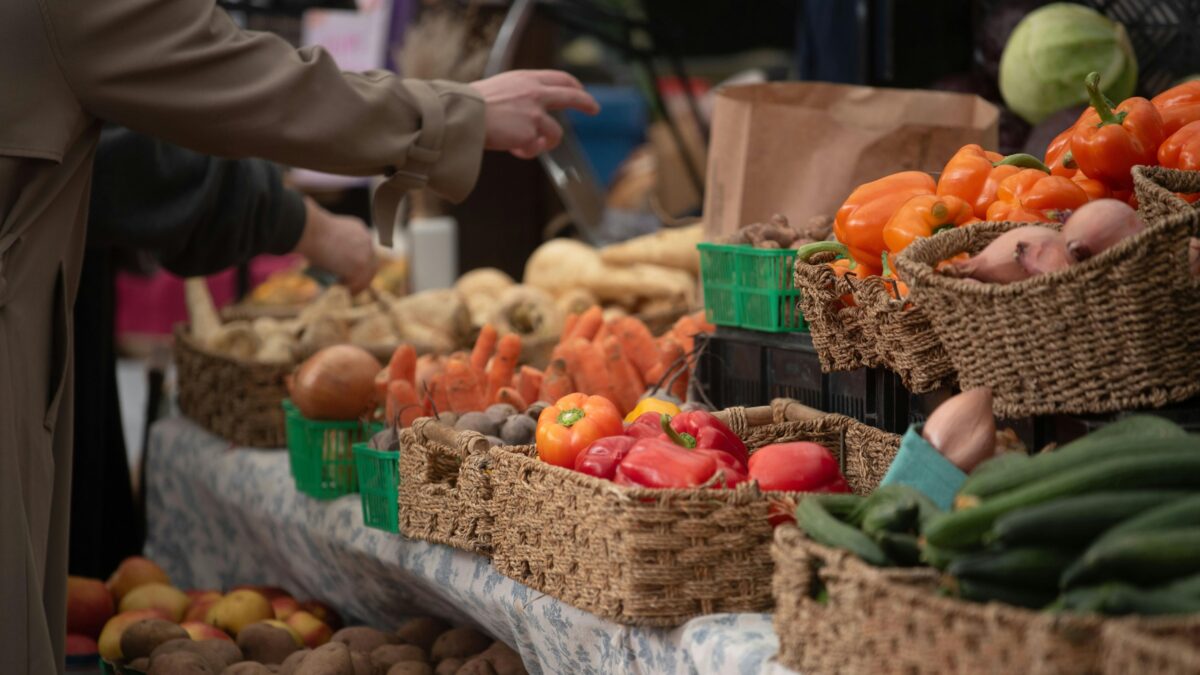
In Singapore, "buying local" is not a lifestyle choice. It is a national security question — and a personal one too.
The Number That Should Make You Think
Singapore imports more than 90 per cent of its food. That single figure — published by the Singapore Food Agency and consistent for decades — is the starting point for almost every honest conversation about food in this country.
It is not a criticism. It is geography. With just over 700 square kilometres of land and a population of nearly six million, Singapore has never had the agricultural base to feed itself through conventional means. Global trade made this city-state rich, and global trade feeds it. The system has worked extraordinarily well — until it hasn't.
In 2020, Malaysia's COVID-19 border closures triggered panic-buying overnight. In 2022, a Malaysian chicken export ban left hawker centres without the centrepiece of Hainanese chicken rice. The Russia-Ukraine conflict disrupted global fertiliser and feed chains, and Singapore felt it not through proximity, but through the invisible threads of supply that underpin everything on a local plate. These were not freak events. They were previews of the new operating environment: one where climate shocks, geopolitical tensions, and export nationalism are recurring features, not exceptions.
This article is not an argument against imports. Singapore will always depend on them. It is an argument for something more precise: that local produce and locally made goods play an irreplaceable role in Singapore's food system — one that goes beyond freshness, beyond feel-good signalling, and into genuine resilience.
What "Local" Actually Means
The word "local" gets used loosely. It is worth being precise.
Locally grown produce is food cultivated within Singapore — vegetables, eggs, fish, and increasingly, novel proteins. This is what the Singapore Food Agency's "30 by 30" goal targets: producing 30 per cent of nutritional needs locally by 2030, up from less than 10 per cent in 2019. In November 2025, those targets were revised — producing 20 per cent of fibre (leafy vegetables) and 30 per cent of protein (eggs and seafood) by 2035. As of 2024, Singapore stood at eight per cent of fibre and 26 per cent of protein consumed locally. Progress, but the road ahead is significant.
Locally manufactured goods are food products made in Singapore, even if some ingredients are imported. A snack, sauce, or ready-to-eat product manufactured here by a Singapore company — employing local workers, paying local taxes, building local capability — is "local" in the sense that matters economically and socially.
These two categories are distinct but complementary. Both are worth understanding in more depth than "it's fresher" or "it supports a small business." And neither is automatically the same as organic or low-carbon — the science on food miles is nuanced, with production methods often mattering more than transport distance for total emissions. But local does mean shorter supply chains, less packaging, less cold chain energy, and more direct accountability — and in Singapore's context, something even more important: reduced exposure to decisions made elsewhere.
The Food Security Case
Food security rests on four pillars: availability, access, utilisation, and stability. Singapore performs well on the first three under normal conditions. It is stability — the ability to maintain supply during disruption — where the import-dependent model is structurally exposed.
The SFA addresses this through "three food baskets": diversifying import sources, growing locally, and growing overseas through Singapore-linked farms. The local basket is the most resilient of the three — it cannot be delayed by a shipping bottleneck.
Eggs illustrate the difference local production makes. By 2024, locally produced hen shell eggs covered over 30 per cent of Singapore's total egg consumption — one of the few food categories where the 30 by 30 benchmark has already been met. In a disruption, those farms in Lim Chu Kang and Jurong keep supplying, regardless of what is happening in Malaysia, Brazil, or Poland.
This is why farms like Chew's Agriculture, ComCrop, and VertiVegies are not simply agricultural businesses — they are national infrastructure, because food production is a strategic capability, not just a commercial one.
Choosing locally grown produce — a box of Chew's eggs, a bag of ComCrop lettuce — is not only a preference. It is a participation in the infrastructure of national food security. Every purchase that keeps a local farm commercially viable extends Singapore's buffer capacity.
The Food Waste Case
Shorter supply chains reduce food loss. When produce travels from Cameron Highlands, vegetable fields in China, or seafood operations in Norway, it passes through harvest, packing, cold storage, port loading, shipping, distribution, wholesale, and retail — multiple points where temperature fluctuations, delays, and damage accumulate. The longer the journey, the more opportunities for loss.
Local chains compress this sequence dramatically. A vegetable grown in a vertical farm in Jurong and delivered to a supermarket in Buona Vista may travel a handful of kilometres and change hands twice. Research in Frontiers in Sustainable Food Systems confirms this: shorter chains reduce food damage and waste by delivering fresher produce through more direct routes.
Local farms also have more flexibility to sell cosmetically imperfect produce — slightly misshapen or undersized food that import-dependent retail systems reject because it cannot survive a long journey. Shorter chains are more tolerant of imperfection, which means less food is discarded before it reaches anyone.
Singapore generated approximately 784,000 tonnes of food waste in 2024 — about 12 per cent of the total waste stream — with only 18 per cent recycled, according to the National Environment Agency. Reducing waste at the disposal end matters. But preventing it upstream, through shorter and more local supply chains, is more efficient still.
The Economic and Social Case
When you buy locally grown produce or a locally made product, a larger share of that expenditure stays in Singapore. It pays wages across the supply chain — the farm worker, the food technologist, the logistics driver, the packaging supplier. It builds organisational capability that makes the food economy more robust over time.
The agri-food sector is small — agriculture contributes less than 0.5 per cent of GDP — but it is strategic. As of 2024, there were 153 land-based and 72 sea-based food farms, with total local food production estimated at S$231 million by the SFA. That capability base shrinks through commercial indifference and strengthens through deliberate purchasing choices.
There is a cultural dimension too. Singapore's food identity — the hawker centre, the wet market, the specific textures and flavours of Singaporean cuisine — was built around particular local ingredients and preparation methods. Choosing local produce and locally made goods maintains that connection. It is harder to run a hawker stall with integrity when every component is globally commoditised and indistinguishable.
A 2024 YouGov survey of over 800 Singapore residents found that three in four who regularly buy eggs do so locally at least half of the time. Demand for local seafood and vegetables is lower but growing. The appetite is there — the gap is in making local food easier to find and better understood, which is what the SFA's "SG Fresh Produce" logo and its periodic Farmers' Markets are designed to address.
What's In It For You — The Everyday Individual
Most conversations about buying local are aimed at either policymakers or businesses. But the everyday Singaporean — the one doing the weekly FairPrice run, packing a lunchbox, or ordering from a hawker — is the most important actor in this system.
Here is what is concretely in it for you.
Fresher food, less often wasted at home. Locally grown produce travels shorter distances and spends less time in cold storage before it reaches you. That translates directly into longer shelf life in your fridge and less food going off before you get to use it. Fewer trips to throw out limp vegetables. Less money in the bin.
You can actually know where it came from. With imported produce, traceability is opaque at best. A locally grown vegetable from a Singapore farm — especially one bearing the SFA's "SG Fresh Produce" mark — comes with a shorter, more verifiable supply chain. You can know the farm. Some farms welcome visits.
Your spending has a compounding impact. Every dollar spent on locally grown food or a Singapore-made product contributes to the commercial viability of a farm or manufacturer that the country needs. It is not charity — it is choosing to spend where the impact is visible and close. Over time, those choices aggregate into a market signal that determines whether local farms survive, expand, or close.
It connects you to Singapore's food culture. Buying a locally made sauce, a Singapore-produced snack, or vegetables from a Singapore farm is a small act of cultural continuity. It maintains the relationship between what Singaporeans eat and the place they live. That relationship is worth preserving — not as nostalgia, but as identity.
None of this requires a dramatic overhaul of how you shop. It starts with one habit: check whether a local option exists before defaulting to the imported one.
What This Means for Corporates and Schools
For businesses managing office pantries, school canteens, and corporate cafeterias, the decision to prioritise local produce and locally made goods is both a values statement and a risk management decision.
From a supply chain risk perspective, procurement teams that over-index on imports are exposed to the same disruptions that affect Singapore as a nation. A supplier network that includes local options has flexibility when the next ban, border closure, or shipping delay arrives.
From a cultural perspective, the choice of what a company feeds its people is increasingly visible. Younger employees are attentive to whether employer decisions align with stated values. A pantry stocked with locally made products is a daily, tangible expression of that commitment — it communicates itself every time someone opens the cupboard, without a policy announcement required.
For schools, the calculus is even more direct. What a school serves in its canteen is a lesson about value, about origin, about what the institution believes is worth spending money on. A school that serves locally grown vegetables, Singapore-farmed eggs, and locally made snacks is modelling the behaviours it would want students to carry into adult life. That is not incidental. It is pedagogy.
The Honest Nuance
A credible case for local does not require ignoring the counterarguments.
Local food in Singapore is generally more expensive than imported equivalents. Singapore's production costs — energy, labour, land — are among the highest in the region, and local farms do not have the economies of scale available to large offshore producers. The SFA's chief executive, Damian Chan, acknowledged in 2025 that higher energy costs remain one of the key challenges facing local farms.
The carbon footprint of "local" is also not straightforwardly lower. Production methods — the energy intensity, the feed used, the farming system — matter more to total emissions than distance travelled. A vegetable grown in a high-energy indoor vertical farm in Singapore may have a larger carbon footprint than one grown in a field in Malaysia with natural light.
These nuances matter. The case for local has to rest on arguments that actually hold — food security resilience, supply chain stability, economic multiplier effects, waste reduction, and cultural identity — not on an oversimplified "local equals sustainable" equation. Buying local is a deliberate act, not a reflexive one.
A Direction Worth Choosing — Together
Singapore's revised food security targets through 2035 are a national bet on resilience. They are a recognition that a city-state which produces none of its own food is more vulnerable than one that produces some, and that "some" is worth investing in even when imports are cheaper.
But government funding and farm infrastructure are only part of the equation. The demand signal that determines whether local farms and local manufacturers survive comes from consumers, companies, and schools making deliberate choices — regularly and collectively. The government can fund capability. The private sector can invest in technology. Schools can teach the values. But none of it is commercially viable without a market.
Building that market is an ecosystem effort. It means consumers choosing the local egg at FairPrice. It means companies sourcing local snacks for their pantries. It means schools serving locally grown food in their canteens and explaining why. It means food manufacturers building products from Singapore-grown ingredients. Every part of the system reinforces every other part — and every part starts with a choice that is available today.
The disruptions will come again. The question is whether Singapore's food system — and the habits of the people and institutions within it — will be ready.
How Moonbeam Fits Into This Ecosystem
At the moonbeam co., we manufacture in Singapore, source upcycled ingredients, and supply corporate pantries and school canteens that want their food choices to mean something beyond taste. We are one part of the local food ecosystem — and we believe the ecosystem is what matters.
Supporting local is not about any one brand. It is about building the conditions in which Singapore can grow, make, and eat food with confidence — regardless of what is happening across the Causeway or on the other side of the world.
Explore our snacks | Learn our story | Partner with us
References
Ministry of Sustainability and the Environment. (2025, November 4). Speech by Minister Grace Fu at the Asia-Pacific Agri-Food Innovation Summit, Singapore International Agri-Food Week. https://www.mse.gov.sg/latest-news/asia-pacific-agri-food-innovation-summit--singapore-international-agri-food-week----ms-grace-fu/
National Environment Agency. (2024). Waste statistics and overall recycling 2024. https://www.nea.gov.sg/our-services/waste-management/waste-statistics-and-overall-recycling
Poore, J., & Nemecek, T. (2018). Reducing food's environmental impacts through producers and consumers. Science, 360(6392), 987–992. https://doi.org/10.1126/science.aaq0216
Singapore Food Agency. (2024). A sustainable food system for Singapore and beyond. https://www.sfa.gov.sg/food-for-thought/article/detail/a-sustainable-food-system-for-singapore-and-beyond
Singapore Food Agency. (2024). Staying ready and steady for future food disruptions. https://www.sfa.gov.sg/food-for-thought/article/detail/staying-ready-and-steady-for-future-food-disruptions
Singapore Food Agency. (2024). Singapore food statistics 2024. SFA.
Stein, A. J., & Santini, F. (2022). The sustainability of "local" food: A review for policy-makers. Review of Agricultural, Food and Environmental Studies, 103(1), 77–89. https://doi.org/10.1007/s41130-021-00148-w
Tortajada, C., & Lim, N. S. W. (2021). Food security and COVID-19: Impacts and resilience in Singapore. Frontiers in Sustainable Food Systems, 5. https://doi.org/10.3389/fsufs.2021.740780
United States Department of Agriculture Foreign Agricultural Service. (2022). Malaysia bans poultry export in latest attempt to curb inflation. https://apps.fas.usda.gov/newgainapi/api/Report/DownloadReportByFileName?fileName=Malaysia+Bans+Poultry+Export
YouGov Singapore. (2024, June). Local vs imported food: Which do most consumers in Singapore prefer and why? https://sg.yougov.com/consumer/articles/49871-local-vs-imported-food-which-do-most-consumers-in-singapore-prefer-and-why