
Most of us are throwing away more than we realise — and most of it is avoidable. Here's exactly what to do instead.
The Problem Starts Before the Bin
Before anything ends up in the bin, it went somewhere else first.
It sat in the back of the fridge. It got pushed behind something. The date passed and nobody noticed until the smell arrived.
That's the real story of household food waste — not carelessness exactly, but a slow accumulation of small moments where the right habit didn't exist.
Globally, households are responsible for over 631 million tonnes of food waste every year — the single largest source of food loss at the consumer level, accounting for approximately 60% of all food discarded (UNEP, 2024). For the average household, that translates to roughly 79 kilograms of food wasted per person, per year. For a family of four, you're looking at a full wardrobe's worth of food thrown away annually.
The good news: a significant share of that waste is downstream of a decision. Meaning it happens because of something — wrong storage, misread dates, no plan for the leftovers — not inevitably.
This guide gives you the habits, the hierarchy, and the honest answers to the awkward questions. What goes where. What you're doing wrong with your fridge. And what actually belongs in the drain versus what's quietly destroying your pipes.
The Three Questions Worth Asking Before Anything Goes in the Bin
Not everything that feels like waste actually is. Before something goes out, it's worth asking these three questions in order.
1. Can I still eat it?
Best-before dates are about quality, not safety. That yoghurt a day past the label? Almost certainly fine. The slightly stale bread? Better as toast, perfect as breadcrumbs. What you're looking for is sensory change — an off smell, unusual texture, visible mould. Date labels alone are an unreliable guide to whether food has actually spoiled, and over-reliance on them is one of the leading causes of perfectly edible food being thrown away (UNEP, 2024).
2. Can someone else use it?
If it's still good but you won't get to it — a tin you overbought, produce sitting before a trip away — platforms like OLIO and Too Good To Go exist exactly for this moment. You pass it on; someone else uses it. Food banks also accept unopened, in-date goods and are often more accessible than people realise.
3. Can I compost it?
Composting is always better than landfill. Food that goes to landfill decomposes without oxygen and produces methane — a greenhouse gas roughly 80 times more potent than CO₂ over a 20-year period (UNEP, 2024). Composting redirects that material back into something useful. More on what can and can't go in below.
If none of the above apply, the bin is the answer. But knowing which bin matters more than most people think.
What Composting Can Actually Handle
Home composting is one of the most impactful things a household can do with food scraps — and most people either underuse it or put the wrong things in and wonder why it's not working.
What goes in
All raw fruit and vegetables. Peels, cores, seeds, rinds, wilted leaves. Everything. Even citrus, though in moderation if you're using a worm bin — the acidity can stress the worms over time.
Cooked grains, pasta, and bread. In an enclosed bin (which most home composters are), this is fine. In an open outdoor heap, cooked starchy food can attract pests — so use an enclosed system.
Coffee grounds and unbleached paper filters. Excellent for compost. They add nitrogen and improve drainage. One of the easiest swaps you can make.
Tea bags — check first. A significant proportion contain a small plastic mesh that doesn't break down. If yours do, empty the leaves and compost those; the bag itself goes in the bin.
Eggshells. Slow to break down, but worth adding — they contribute calcium and help balance acidity. Crush them to speed things up.
Paper towels, egg cartons, and torn cardboard. These are "browns" — carbon-rich material that balances the wet food scraps and keeps the heap from turning into a soggy mess.
What doesn't go in a home composter
Meat, fish, and bones. These will attract rats and produce serious odour in an outdoor heap. They go in the food waste caddy if your council collects one, or in the general bin.
Dairy products. Same issue. Cheese, milk, yoghurt — caddy or general bin.
Cooking oils in quantity. A small amount won't ruin a heap, but oil coats organic material and slows the breakdown process. Don't pour fat into the composter.
Diseased plants. If a plant has visible blight, mould, or pest damage — don't compost it. You risk spreading the problem back into your garden the next time you use the compost.
The Food Waste Caddy: Making It Work
If your council provides a food waste caddy or kerbside collection, it opens up options your home composter can't handle — meat, fish, dairy, cooked food. The collected material is typically processed into biogas (energy) or high-quality compost at industrial facilities, where the conditions are managed at a level a garden heap can't replicate.
Line it right. Most councils specify compostable liners — regular plastic bags aren't accepted because they don't break down in the process. Check what your council recommends. Some accept newspaper lining instead.
Smell bothering you? Keep the caddy in the fridge or freeze scraps until collection day. A small bag in the freezer for fish trimmings and meat scraps, emptied weekly, solves the odour problem entirely. There's no rule that says food waste has to sit at room temperature.
Empty it often. Little and often is far easier to manage than a full caddy sitting through a hot week.
What Actually Belongs Down the Drain — and What Doesn't
The kitchen sink is one of the most routinely abused disposal routes in the home. A few things worth knowing:
Cooking oil and fat — never down the drain. Oil solidifies as it cools, accumulates, and is the leading cause of domestic drain blockages and the larger sewer "fatbergs" that cost water authorities millions to clear. Fats, oils, and grease cause over 20,000 blockages per year in the Thames Water network alone — 28% of all their sewer blockages — costing around £40 million annually to clear (Thames Water, 2026). Let oil cool completely, pour into a sealed bottle or carton, and take it to a cooking oil recycling point — most local recycling centres have one.
Coffee grounds — feel harmless, but they accumulate over time and do cause pipe blockages, particularly in older plumbing. Compost them; they're excellent for it.
Starchy water — rice water and pasta water won't immediately block a drain, but in large quantities they contribute to build-up over time. Fine in moderation.
Vegetable peels — even with a food waste disposal unit, fibrous peels (celery, onion skins, artichoke) can tangle around the blades. Better to compost them.
The Storage Habits That Prevent Waste Before It Starts
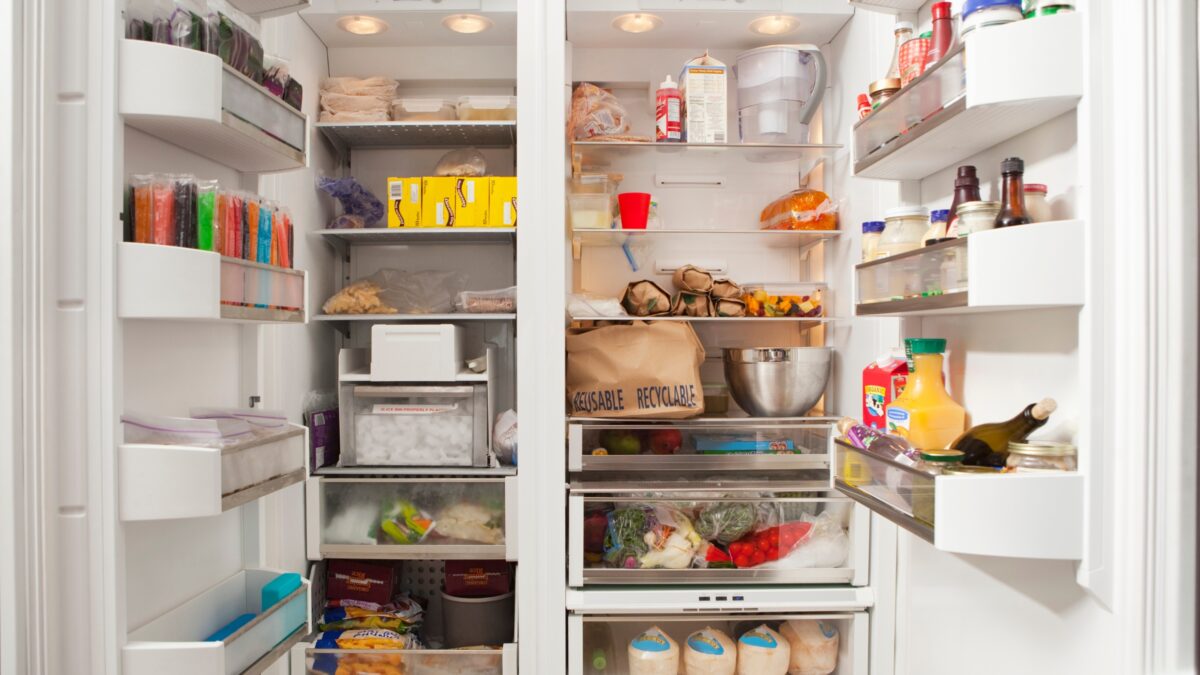
Most household food waste doesn't start at the bin. It starts at the fridge.
Move older food to the front. New shopping goes behind existing stock. Older items come forward. This sounds trivially obvious — and it is — but it's one of the single most effective habits you can build, because most waste happens when food is simply not seen until it's too late.
Use the freezer more aggressively. Bread, cooked rice, bananas going brown, soft herbs, grated cheese, leftover stock — almost all of it freezes well. If something is approaching its use-by date and you won't eat it today, the freezer is a pause button. Use it before the food reaches the point of no return.
Know what doesn't belong in the fridge. Tomatoes lose flavour and develop a mealy texture when refrigerated. Potatoes sprout faster in the cold. Onions go soft. Bananas blacken. Most of these are better at room temperature until cut.
Store fresh herbs like flowers. Stand them upright in a small glass of water, loosely covered with a bag, in the fridge or on the counter. A bunch that would last three days flat in a drawer can last a week or more this way.
The Awkward Questions Nobody Asks
Mouldy food — how much do you cut off?
On hard cheeses and firm vegetables, cut at least 1cm around and below any visible mould spot. The mould you can see is the surface; cutting with a margin removes the parts that have been affected underneath. On soft foods — bread, berries, soft cheese, yoghurt — visible mould means the whole thing has been affected. Bin it.
Compostable packaging — does it go in the home composter?
Not necessarily. "Biodegradable" and "compostable" are not the same thing, and home-compostable and industrially-compostable are different categories. Look for the seedling logo or explicit "home compostable" labelling. Industrial compostable packaging — often marked with a different certification — needs the high temperatures of a commercial facility to break down. In a home composter, it'll just sit there indefinitely. When in doubt: bin it, or check with your council.
Frying oil that's been used many times?
When oil has gone dark and starts smoking at lower temperatures than before, it's done. Cool it completely, pour it into a sealed container — an old oil bottle, a carton — and take it to a cooking oil recycling point. Don't bin it while still liquid.
Leftover wine or alcohol?
Small quantities down the drain are fine. Large quantities, particularly spirits, are worth checking with your local authority — some specifically ask that you don't. Old wine is better used: add it to a braise, reduce it into a sauce, or freeze it in ice cube trays for cooking.
Quick Reference: Where Does It Go?
| Item | Home compost | Food waste caddy | General bin |
|---|---|---|---|
| Raw fruit & veg scraps | ✅ | ✅ | — |
| Cooked food (no meat) | ✅ enclosed bin | ✅ | — |
| Meat and fish | ❌ | ✅ | if no caddy |
| Dairy | ❌ | ✅ | if no caddy |
| Eggshells | ✅ | ✅ | — |
| Coffee grounds | ✅ | ✅ | — |
| Tea bags (plastic-free) | ✅ | ✅ | — |
| Cooking oil | ❌ | ❌ | ✅ sealed |
| Mouldy soft food | ❌ | ✅ | if no caddy |
| Compostable packaging | Check label | Check with council | if unsure |
| Bones | ❌ | ✅ | if no caddy |
Why It Adds Up
Household food waste generates an estimated 8–10% of global greenhouse gas emissions — nearly five times the total emissions from the aviation sector (UNEP, 2024).
That number is both alarming and, in a way, encouraging. It means that household decisions — individually modest, collectively enormous — sit at the centre of one of the most solvable parts of the climate problem. You don't need new infrastructure or a policy change. You need a bag in the freezer and a habit at the fridge.
None of this requires perfection. Getting two or three of these habits right, consistently, makes a real difference to both what you spend on food and what ends up decomposing in a landfill somewhere.
The hierarchy is simple: eat it first. Pass it on if you won't. Compost what you can. Caddy what you can't. Keep it out of the drain. What's left goes in the bin.
At Moonbeam, We Start With What Others Throw Away
Our snacks are made from upcycled ingredients — the parts of the food system that conventional supply chains discard. It's not a marketing angle. It's the whole operating model.
Understanding what happens to food after it leaves a kitchen — and before it reaches ours — is part of how we build better food.
Explore our snacks | Learn our story | Partner with us
References
Thames Water. (2026, March). Thames Water clears 500-metre fatberg near Heathrow. https://www.thameswater.co.uk/news/2026/mar/thames-water-clears-500-metre-fatberg-near-heathrow
United Nations Environment Programme. (2024). Food Waste Index Report 2024. UNEP. https://www.unep.org/resources/publication/food-waste-index-report-2024
WRAP. (2025). Household food and drink waste in the UK 2022. Waste & Resources Action Programme. https://www.wrap.ngo/resources/report/household-food-and-drink-waste-uk-2022